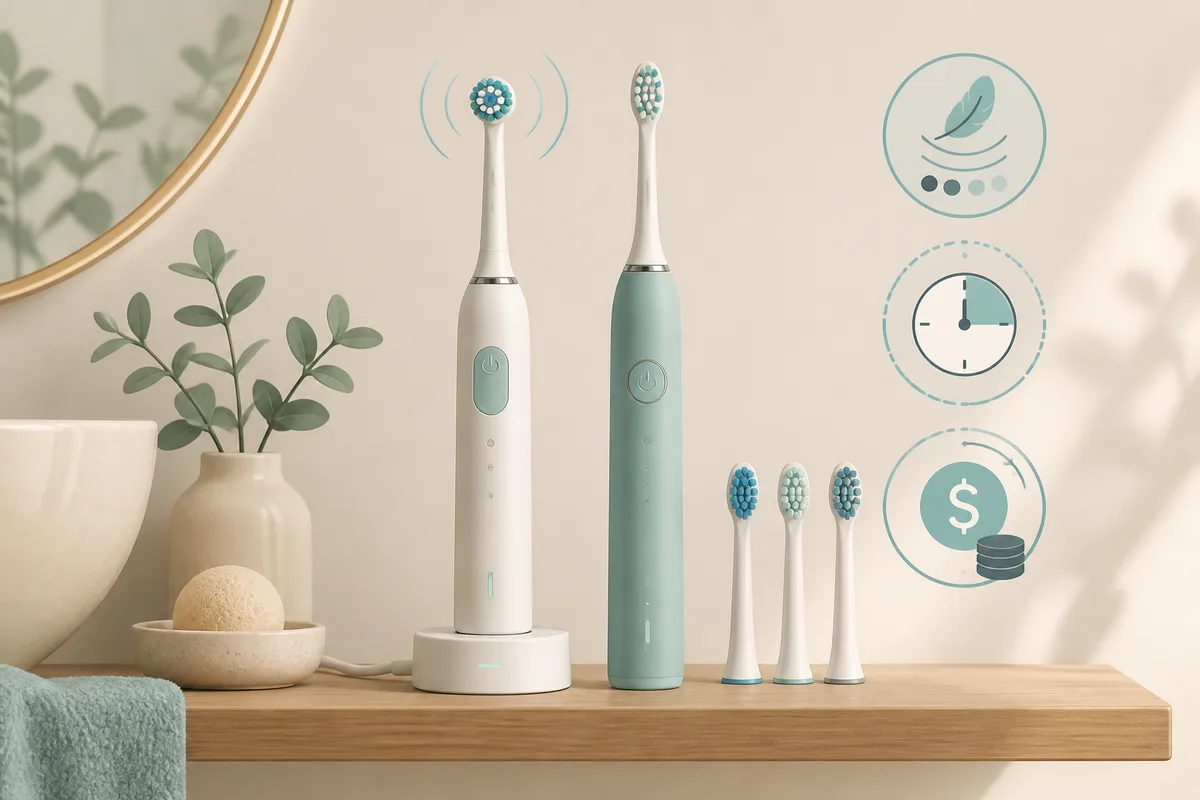
Buying your first rechargeable toothbrush? Start with the features you will use twice a day—not the longest list of cleaning modes. My suggested shortlist is simple: noticeable pressure feedback, a two-minute timer, comfortable replacement heads and charging that fits your routine.
This guide compares practical features using manufacturer specifications and independent dental evidence. It is not a hands-on test or a ranking of cleaning performance.
Is switching from a manual toothbrush worthwhile?
An electric toothbrush is an option, not a requirement. The American Dental Association says both manual and powered brushes can remove plaque effectively. Powered brushes may be easier for people with limited dexterity or dental appliances such as braces.
Independent evidence suggests an average advantage for powered brushing. A Cochrane review found moderate-quality evidence of lower plaque and gingivitis levels compared with manual brushing. At more than three months, the reported differences corresponded to about 21% less plaque and 11% less gingivitis on the measurement scales used—not those percentages fewer cavities or lost teeth.
There is an important limitation: the review searched studies only through January 23, 2014. Its findings support the category, but do not establish that a particular current toothbrush is superior. The authors also said the clinical importance and implications for long-term dental health remained unclear.
Whichever brush you choose, the ADA recommends soft bristles, fluoride toothpaste and brushing twice daily for two minutes. If consistency is your main challenge, start with a manageable schedule; our guide to building a wellness routine that works for you offers broader habit-planning ideas.
Prioritize pressure feedback you will notice
“Pressure sensor” does not describe one standard experience. Compare what happens when you press too hard: does the handle show a light, change its vibration or make a distinct sound?
Two current manufacturer examples illustrate the difference:
| Model | Documented pressure feedback | Timing and controls | Who might shortlist it |
|---|---|---|---|
| Oral-B iO Series 3 | Visible light-ring feedback for too little, appropriate or excessive pressure | Two-minute timer; Daily Clean, Sensitive and Whitening modes | Someone who prefers a visible pressure cue |
| Philips Sonicare 4100, HX3681/23 | Pulsing sound and reduced vibration when excessive pressure is detected | Two-minute timer and 30-second pacing | Someone who prefers sound and vibration feedback |
These are feature comparisons, not evidence that one cleans better. Manufacturer plaque-removal slogans are marketing claims, not interchangeable results from a head-to-head trial.
Before buying, ask whether you could actually perceive the warning. A light is less useful if you never see it; a sound may be less useful if hearing it is difficult. If possible, inspect a display handle and check the return policy.
Pressure feedback is a reminder, not permission to scrub harder. The ADA advises gentle pressure and soft bristles.
Choose timing help before app extras
My recommendation for a first brush is a two-minute timer plus pacing reminders. The 4100’s 30-second QuadPacer, for example, provides a cue to move through sections of your mouth.
Remember that elapsed time is not the same as coverage. You still need to clean the inner, outer and chewing surfaces, as the ADA explains.
Treat phone connectivity as optional. Before paying for app coaching, ask:
- Will I bring my phone into the bathroom consistently?
- Can I use the timing and pressure features without opening an app?
- What permissions or account setup are required?
- Would simpler controls make me more likely to use the brush?
For this guide, I would prioritize clear feedback and affordable heads over dashboards, scores or extra modes. That is a usability recommendation, not a claim that apps never help.
Check replacement heads before choosing the handle
A familiar brand name does not guarantee compatibility. Oral-B specifies that iO handles use iO heads; its earlier Pro, Smart, Genius and Vitality ranges use a different head family. Existing non-iO refills should not be counted as supplies for an iO purchase.
Likewise, Philips’ compatibility guide lists HX368x handles among those accepting standard click-on Sonicare heads, while Philips One uses its own heads.
Save the exact handle model number and compatible refill name. Then check:
- Is there a soft-bristled option you want to use?
- Can you comfortably maneuver the head around your back teeth?
- Are compatible refills sold where you normally shop?
- What is the price per head, rather than per package?
Do not buy a large refill bundle until you are comfortable committing to that brush system.
Calculate the recurring cost
The ADA recommends replacement approximately every three to four months, or sooner when bristles become frayed. For budgeting, four heads per year is a useful planning assumption—not a promise that every head lasts exactly three months.
At the time of research, Oral-B’s official iO refill page listed Ultimate Clean heads at $29.99 for two and $49.99 for six. At four heads annually, that works out to approximately $60 versus $33 per year, respectively, before tax and any shipping. These are annualized usage costs; you still pay the full package price upfront. Prices can change.
For a two-year comparison, add:
Handle price + replacement packs needed after included heads + required charging accessories.
Compare actual pack quantities and avoid counting included heads twice. A discounted handle is less appealing if its refills strain your budget.
Read the charging details carefully
Before checkout, verify the exact package contents, connector type, wall-adapter requirements, full-charge time and manufacturer-rated battery life. Also check warranty and service options rather than assuming the battery can be replaced at home.
USB charging does not automatically mean every phone adapter is suitable. Philips’ adapter guidance specifies 5-volt output and at least 1 amp for the products it covers, and calls for a splash-proof IPX4 adapter in moist environments. Follow the instructions for your exact model.
If work schedules disrupt your routine, consider where charging and storage will realistically happen. Our wellness-at-work guide offers broader ideas for organizing self-care around working days. A manual backup may be simpler than buying a second charging setup.
Who should consider alternatives?
Keep a manual brush if you use it comfortably and prefer to avoid charging or recurring head costs. Both brush types can work effectively, according to the ADA.
Keep your existing electric brush if it works properly, suits your needs and has affordable compatible heads. Identify a specific problem before upgrading: unclear pressure feedback, awkward controls or inconvenient charging—not simply a newer model number.
Seek dental advice rather than another gadget if your gums bleed regularly. The ADA’s bleeding-gum guidance recommends discussing this with a dentist.
Finally, an electric brush does not replace cleaning between teeth or professional care. NIDCR recommends daily interdental cleaning and routine dental visits; hardened tartar requires professional removal.
The best purchasing question is straightforward: Which brush gives me useful feedback, manageable upkeep and a routine I can sustain?
Sources
- https://www.cochrane.org/evidence/CD002281_poweredelectric-toothbrushes-compared-manual-toothbrushes-maintaining-oral-health
- https://www.ada.org/resources/ada-library/oral-health-topics/toothbrushes
- https://www.mouthhealthy.org/all-topics-a-z/toothbrushes
- https://oralb.com/en-us/products/io-series-3-rechargeable-electric-toothbrush-icy-blue-dd/
- https://www.usa.philips.com/c-p/HX3681_23/4100-series-sonic-electric-toothbrush
- https://oralb.com/en-us/products/replacement-brush-heads/io-brush-heads/
- https://www.usa.philips.com/c-f/XC000006597/which-brush-head-fits-my-sonicare-toothbrush
- https://www.mouthhealthy.org/all-topics-a-z/bleeding-gums
- https://www.nidcr.nih.gov/health-info/oral-hygiene