The NeilMed Sinus Rinse squeeze-bottle kit is worth considering if you want to try nasal irrigation and can commit to preparing the solution and cleaning the equipment properly. For a first-time buyer, those habits matter more than buying the largest packet bundle.
This research-based guide explains what to buy, what relief to reasonably expect, and when a different approach makes more sense.
Safe water comes first
Never rinse your nose with untreated tap water. The CDC recommends distilled, sterile, or previously boiled and cooled water. Rare but potentially fatal infections have occurred after nasal rinsing with contaminated tap water.
For the simplest setup, buy water labeled distilled or sterile. Do not assume ordinary bottled drinking water qualifies. If using tap water, the CDC says to bring it to a rolling boil for one minute—or three minutes above 6,500 feet—then let it cool. Store unused boiled water in a clean, sanitized container with a tight cover. These are the CDC’s nasal-rinsing instructions, rather than a shortcut based on whether water is drinkable.
Safe water still needs the correct saline mixture. The FDA notes that plain water can irritate nasal tissues. Water safety and salt concentration are separate requirements.
What comes in the kit—and what remains unclear
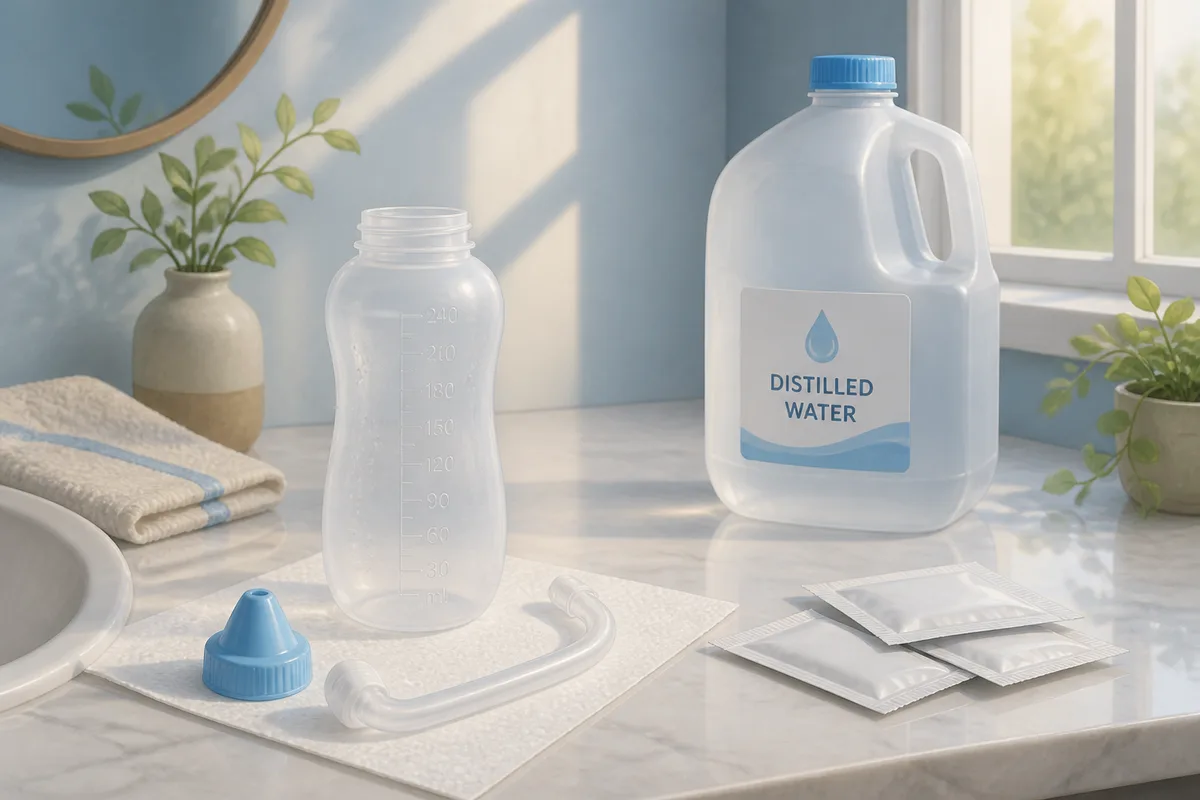
The manufacturer’s kit listing specifies a 240 mL, or 8-ounce, squeeze bottle, premixed sodium chloride and sodium bicarbonate packets, and an educational brochure.
However, the packet count is inconsistent: the page title says 50 packets, while its box-contents section lists 60. We could not resolve that discrepancy from the listing. Check the physical package or ask the seller to confirm before comparing value; do not count on receiving the larger quantity.
For your first purchase, choose a kit that explicitly includes the bottle. The separate 100 regular premixed packets product lists packets and printed information, but no bottle. “Premixed” here means the dry ingredients are already measured—not that the box contains ready-to-use liquid.
My buying suggestion: start with the standard kit rather than a large refill order until you know whether the routine suits you.
What saline rinsing can—and cannot—do
Nasal irrigation washes saline through the nasal passages. The FDA explains that it can remove pollen, dust and other debris and loosen thick mucus. That makes it a symptom-management option, not proof of infection prevention or a cure.
A 2018 Cochrane review of allergic-rhinitis trials found that saline irrigation may improve symptoms compared with no irrigation, but the evidence was low or very low quality. It did not establish that saline works as well as steroid nasal sprays or identify a clearly superior saline volume or concentration.
NeilMed’s product page describes a soothing experience. Treat that as promotional language, not a guarantee of comfort. This guide does not establish that NeilMed outperforms other irrigation devices.
Preparing and using your first rinse
Read the instructions supplied with your bottle before starting. The following summarizes NeilMed’s directions:
- Wash your hands and start with a clean bottle.
- Fill to 240 mL with safe, lukewarm water. Avoid hot water.
- Add one regular packet. At this volume, one packet makes the standard isotonic solution. Attach the cap and tube, cover the opening with a finger, and shake gently to dissolve.
- Lean forward over a sink with your head tilted down. Keep your mouth open and breathe normally.
- Squeeze gently into one nostril. Allow solution to drain from the other nostril; some may enter your mouth, so spit it out rather than swallowing. NeilMed describes using 60–120 mL on one side before repeating on the other.
- Blow your nose gently, without pinching it completely closed.
Do not improvise a stronger mixture because congestion feels worse. The Cochrane review does not establish that a higher salt concentration is better. Ask your clinician about frequency rather than assuming everyone needs the same schedule.
Cleaning is part of every rinse
The bottle is reusable, but it is not maintenance-free. NeilMed’s cleaning brochure describes washing the bottle, cap and tube after use with a few drops of dishwashing liquid and water, shaking the assembled bottle, and squeezing soapy water through the tube and cap. Rinse away the soap thoroughly, then leave the separated parts to air-dry on a clean paper towel or suitable drying stand.
Do not close the bottle while its parts are wet or seal damp components in a bag. NeilMed also says a dishwasher does not adequately clean the bottle’s interior. For microwave disinfection, follow the instructions supplied with your exact product and microwave wattage rather than improvising a heating time; the manufacturer’s brochure provides specific conditions.
NeilMed recommends replacement within three months of first use, with earlier replacement for deterioration or persistent discoloration. Do not share the device.
Consider adding a replacement reminder to your calendar. If maintenance routines tend to slip, our guide to building a wellness routine that works for you may help you plan a realistic habit—not another unused bathroom purchase.
Ongoing supplies and value
Budget for more than the initial box: packets, safe water, replacement bottles and cleaning supplies all belong in your comparison.
As a planning example, using one packet per session means a confirmed 50-packet box provides 50 sessions; twice-daily use would consume it in 25 days. That is supply arithmetic, not a recommended frequency. A full 240 mL preparation every day uses 7.2 liters over 30 days, before any water used for cleaning.
Compare refill prices per regular packet, then add water and replacement costs. Avoid comparing regular and extra-strength products as though they were identical.
Squeeze bottle, neti pot or saline spray?
| Option | Main distinction | Who should consider it |
|---|---|---|
| Squeeze bottle | Hand pressure moves the saline | Adults comfortable controlling a gentle squeeze |
| Gravity-fed neti pot | Gravity moves the saline | People who prefer pouring rather than squeezing |
| Saline mist spray | Delivers a small moisturizing mist | People mainly seeking moisture rather than a substantial rinse |
Harvard Health’s clinician-reviewed overview explains the pressure-versus-gravity distinction and emphasizes choosing a method that works for you. The FDA distinguishes moisturizing sprays from devices that flush mucus and debris. These options are not interchangeable in purpose.
If indoor air quality is another concern, our Coway Airmega AP-1512HH buying guide addresses a separate purchasing decision; it is not a substitute for evaluating persistent nasal symptoms.
Who should pause or choose an alternative?
NeilMed warns against rinsing with completely blocked nasal passages, an ear infection or blocked ears. Get medical advice after recent ear or sinus surgery, and stop if rinsing causes ear pressure or nasal burning. Its warnings also exclude people unable to stand or bend near a sink.
If your immune system is weakened, consult your clinician first, as the FDA advises. Seek medical care for worsening symptoms rather than repeatedly increasing rinsing. The CDC advises immediate attention for headache, fever, confusion or vomiting after nasal rinsing.
Bottom line: consider the standard kit if you can reliably manage safe water, gentle technique and cleaning. Confirm the packet count before buying. If that upkeep is unrealistic, discuss a simpler symptom-management option with a pharmacist or clinician.
Sources
- https://shop.neilmed.com/products/neilmed-sinus-rinse-kit-with-50-packets
- https://www.neilmed.com/usa/directions-for-use-warnings/
- https://www.neilmed.com/common/use_npsr.php
- https://www.neilmed.com/pdf/NMbrochure/brochure_usa.pdf
- https://www.cdc.gov/naegleria/prevention/sinus-rinsing.html
- https://www.fda.gov/consumers/consumer-updates/rinsing-your-sinuses-neti-pots-safe
- https://www.cochrane.org/evidence/CD012597_nasal-saline-allergic-rhinitis
- https://www.health.harvard.edu/preventive-care/can-nasal-irrigation-help-with-winter-colds-and-congestion