Shopping for an air purifier can get confusing fast. One promises to cover a huge room, another says it’s whisper-quiet, and then you discover the cost of replacement filters.
If you’re considering the Coway Airmega Mighty AP-1512HH for your bedroom, let’s walk through what matters in everyday use: whether it fits your space, how much noise to expect, and what it could cost to keep running.
This guide is based on manufacturer information and independent testing. We haven’t personally tested this purifier at LPH Wellness.
Will it suit your room?
Start by measuring your room. Coway lists several coverage numbers for the Mighty, and they can look confusing at first:
| Air processed per hour | Listed room size |
|---|---|
| 4.8 room volumes | 361 square feet |
| Two room volumes | 874 square feet |
| One room volume | 1,748 square feet |
All three figures describe the same purifier. The difference is how frequently it processes a volume of air equal to the room’s size. They don’t mean every particle disappears after one pass.
For comparing models, focus on the 361-square-foot figure at 4.8 air changes per hour. You can find the numbers in Coway’s specifications.
You’ll also see CADR, short for clean air delivery rate. Coway lists 233 cubic feet per minute for smoke, 246 for dust, and 240 for pollen. Think of these as comparison figures for particle filtration.
There’s a catch: CADR is typically measured at the highest fan speed. High ceilings and open layouts also need more capacity, according to EPA’s sizing guidance. Measure the space you actually want to serve, including any connected area, and compare purifiers at the same air-change rate.
How well does it clean the air?
HouseFresh tested the Mighty in a 728-cubic-foot room. It reached their particle-test endpoint in 26 minutes at maximum speed. With the optional ionizer switched off, that took 29 minutes. On speed two, it took 51 minutes.
That gives you a useful picture of the trade-off: turning the fan down can make it easier to live with, but it also slows filtration.
Your bedroom won’t necessarily match those times. Room layout, pollution sources, and other conditions differ. The useful question is how the purifier performs at the speed you’ll actually use.
Could you sleep with it running?
Noise is personal. A steady fan might fade into the background for you, while someone else notices every change in speed.
Coway publishes a noise range of 24–53 dBA. HouseFresh measured 38.9 dBA on low, 44.4 on medium, and 60.1 on high from three feet away. These measurements came from different setups, so they aren’t directly interchangeable. HouseFresh explains its measurements here.
For a bedroom, check the return policy before buying. If possible, try the purifier where you plan to use it and listen from your pillow. Pay attention to whether automatic fan changes bother you as well as the steady noise.
It’s also worth considering your whole bedtime setup. Our sleep hygiene guide covers habits you can work on alongside choosing bedroom equipment. Buying an air purifier doesn’t guarantee better sleep.
Getting comfortable with the controls
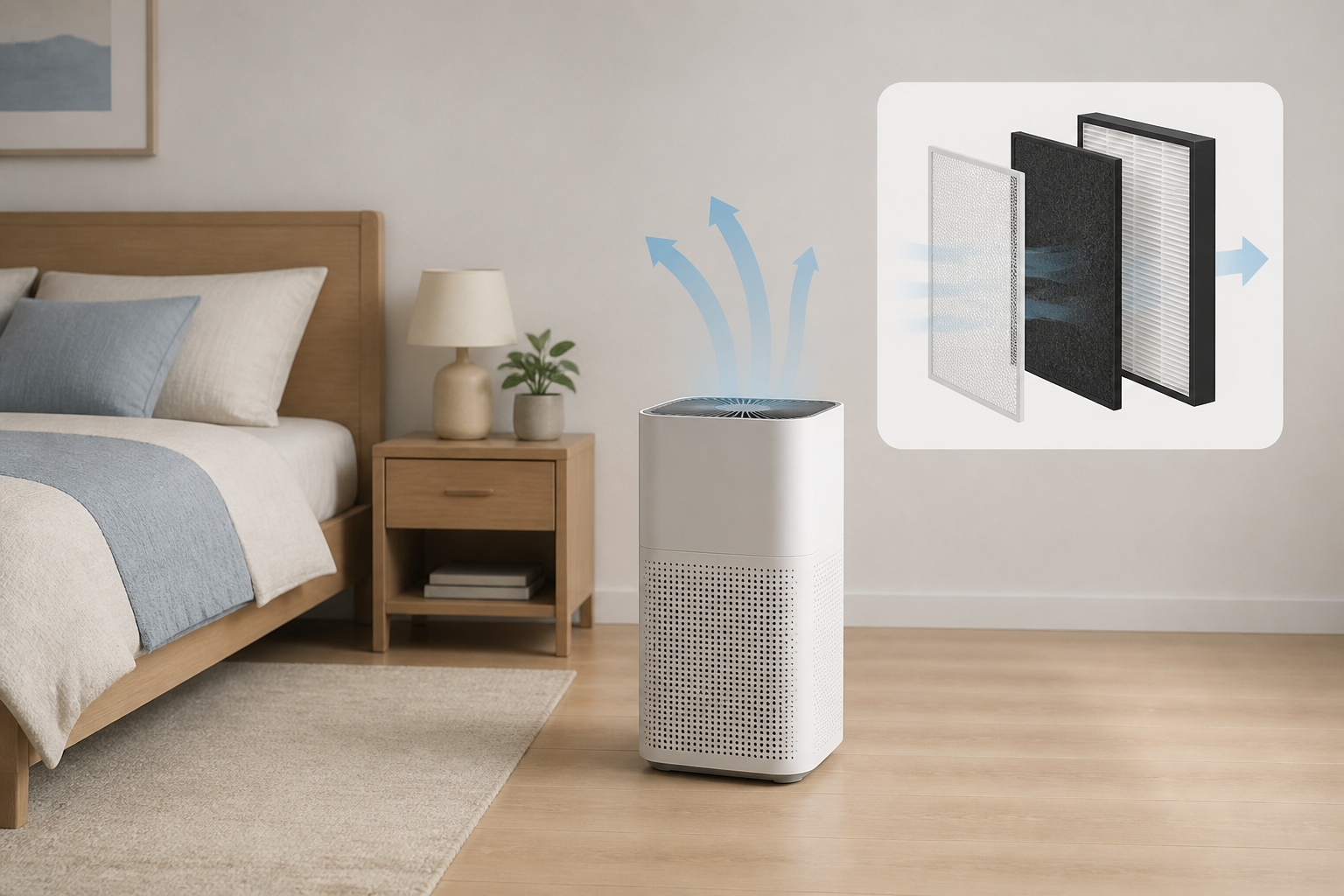
The Mighty has a washable pre-filter, a deodorization filter, a HEPA filter, and an optional ionizer. Auto mode uses a dust sensor to adjust the fan. Eco mode can stop the fan after 30 minutes without detected pollution. Coway describes the settings here.
If you want steady, continuous airflow, choose a suitable manual speed. Eco mode is convenient, but the fan won’t always be running.
You can switch the ionizer off separately. The Coway manual also explains how holding its button for three seconds turns the air-quality indicator light on or off, which may be handy at night.
EPA notes that some ionizing technologies can emit ozone, a lung irritant. That general caution doesn’t establish unsafe ozone levels from this particular model. If you prefer to avoid ionization, you can leave that feature off.
What will it cost after you buy it?
Replacement filters and electricity deserve a place in your budget.
The prices recorded during research for this draft were $239.99 for the purifier and $59.79 for Coway’s Fresh Starter filter set, before applicable tax or changing promotions. That set includes one HEPA filter and two deodorization filters. Check the purifier listing and filter-set listing for the price you’ll actually pay.
Coway recommends changing the deodorization filter every six months and the HEPA filter annually. Its manual bases those intervals on eight hours of daily use at maximum speed. Your conditions may call for a different schedule, so one filter set a year is a starting budget rather than a promise. See the maintenance guidance.
For electricity, HouseFresh measured 75.3 watts on high and 8.7 watts on medium. At an example rate of $0.17 per kilowatt-hour, running continuously would work out to about $112 a year on high or $13 on medium, before filters. Your bill depends on your electricity rate and usage, and those settings provide different cleaning speeds. Here are the measurements behind those examples.
There’s a little upkeep, too. Coway specifies cleaning the pre-filter every two to four weeks and the sensor every two months. Don’t wash the HEPA or deodorization filters; follow the manual for each part. Adding a reminder to your household calendar can help. Our guide to building a wellness routine that works for you offers ideas for making regular tasks manageable.
Another option to compare
The Levoit Vital 200S-P is worth a look if you want app scheduling or an alternative without an ionizer.
Levoit lists coverage of 388 square feet at 4.8 air changes per hour, a CADR of 250 CFM, and rated power of 50 watts. Its standard replacement filter was listed at $49.99 during research. The room-size difference from the Coway is modest; neither figure describes whole-home coverage.
In HouseFresh’s Levoit test, the unit reached the particle-test endpoint in 23 minutes. At maximum speed, it drew 44.55 watts and measured 57.7 dBA. Those results make it worth comparing for electricity use, though high speed still makes noise.
One detail to consider: the Levoit’s particle and carbon filters are bonded together. You can’t replace those components separately. The Coway’s separate filter arrangement may suit you better if that flexibility matters.
Deciding what’s right for your home
The Mighty belongs on your shortlist if you want straightforward controls and particle filtration for a room that fits its capacity. Before buying, check the room measurements, think about the fan speed you’ll tolerate, and allow for replacement filters.
Compare alternatives if app scheduling, lower electricity use on high, or more capacity at a quiet setting matters most to you.
Keep expectations realistic, too. EPA explains that filtration supports efforts to reduce pollution sources and ventilate with clean outdoor air. A portable purifier can’t remove every pollutant or solve a whole home’s air-quality problems.
Particle-filtration ratings also don’t tell you how well a machine removes gases. Persistent odors or moisture-related mold need attention to their source, and an air purifier won’t reliably improve every allergy or asthma symptom. EPA covers these limitations in its guide.
Choose the purifier that fits your room, your budget, and the way you’ll use it every day. Those details matter more than the biggest number on the box.