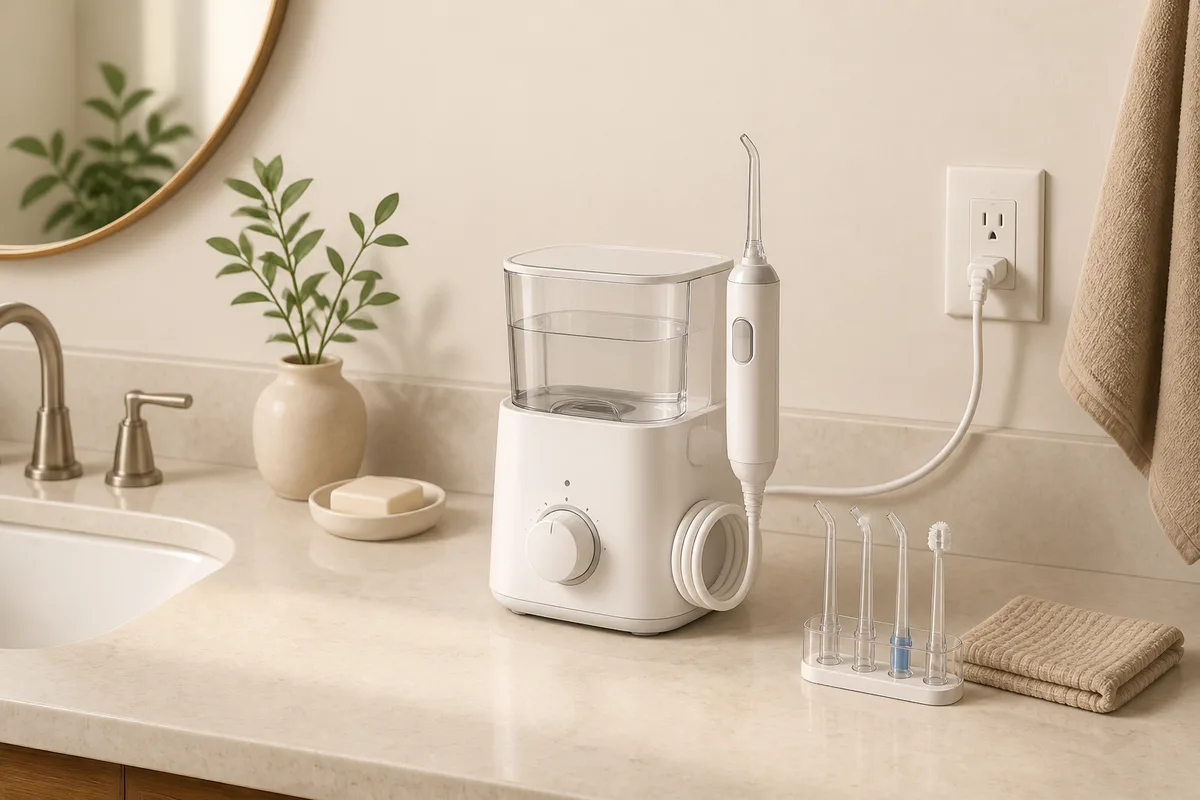
The Waterpik Aquarius WP-660 is worth considering if string floss feels awkward—but first, picture where you would actually use it. A countertop appliance needs more than an empty corner: it needs accessible power, room for refilling, and a maintenance routine you are willing to follow.
This is a researched buying guide, not a hands-on review. Our recommendation is to judge the Aquarius by whether it makes daily interdental cleaning practical, rather than by its strongest advertising claims.
What the WP-660 includes
The current Waterpik specifications list:
| Feature | Manufacturer specification |
|---|---|
| Pressure adjustment | 10 settings |
| Reservoir | 22 ounces/651 mL; advertised 90-plus seconds of use |
| Controls | Rotating tip and water on/off slider on handle |
| Modes | Floss and Hydro-Pulse Massage |
| Timing | One-minute timer with 30-second pacer |
| Size | 10.35 inches high with tip; base 4.70 inches wide by 3.80 inches deep |
| Power | Corded, 120VAC/60Hz; 52-inch cord |
| Warranty | Three-year limited warranty |
The current package lists four Precision tips, one Orthodontic tip, one Plaque Seeker tip, and one Pik Pocket tip—seven tips, not seven different types. Check the retailer’s box contents before ordering because older reviews describe a different assortment.
Measure the bathroom, not just the base
Use the listed dimensions as a starting point, then allow extra room to open the lid, lift the reservoir, and return the handle. Before buying, try placing a cardboard footprint on your counter. Can you still reach the faucet and use the sink comfortably?
Think through three movements: lifting a filled tank, seating it securely, and leaning over the basin while holding the handle. If gripping or lifting is difficult, assess those tasks separately from whether string floss is difficult.
The owner’s manual warns against positioning the appliance where it could fall or be pulled into a sink or tub, handling the plug with wet hands, or using it while bathing. A narrow basin ledge is not a sensible substitute for stable counter space.
Noise deserves consideration, too. In its independent Aquarius review, Electric Teeth described the motor as average rather than exceptionally quiet. That is the reviewer’s observation, not an LPH Wellness measurement. If your bathroom adjoins a bedroom, consider when you would use it. Our broader guide to how your environment affects wellness offers related context on planning a comfortable home environment.
Pressure controls: flexibility, not a target to reach
Waterpik’s operating instructions say to begin oral use at setting 1 and increase gradually according to preference or dental advice. There is no need to work toward the maximum.
Put the tip in your mouth before starting the water and lean over the sink. One easily missed detail: the handle slider stops water flow, but the motor keeps running until you switch off the base. Likewise, the one-minute timer signals with a pause; it does not shut the machine down.
For the everyday Precision tip, Waterpik directs users to aim toward the gumline at approximately 90 degrees and pause between teeth. Ask your hygienist to demonstrate the technique if you are unsure. Treat Massage mode as an optional feature, not the reason to buy.
What dental guidance supports—and what marketing cannot establish
The ADA recommends cleaning between teeth daily alongside twice-daily brushing with fluoride toothpaste. Its patient guidance on flossing recognizes water flossers as an option, including for people who struggle with hand flossing. They do not replace brushing.
Waterpik advertises removal of up to 99.9% of plaque bacteria from treated areas; its product-page footnote identifies a laboratory study with data on file. That percentage is not a prediction of your whole-mouth results or future dental health.
The ADA explains that its Seal of Acceptance requires evaluated evidence of safety and effectiveness. Acceptance is useful reassurance, but it should not be read as a comparative ranking against every other cleaning method.
An independent 2019 Cochrane review found possible short-term reductions in gingivitis with oral irrigation, but evidence was low to very low certainty. Findings for plaque were inconsistent, and no included trials assessed tooth decay. This older, category-level review is not a definitive verdict on today’s WP-660; it does explain why guaranteed superior outcomes would be an overstatement.
Choose tips by need, not quantity
For general use, start by discussing the Precision tip with your dental team. Waterpik recommends replacing that tip every six months.
The Plaque Seeker tip is designed for areas around implants, crowns, bridges, and other restorations, with a three-month replacement interval. The Pik Pocket tip also has a three-month interval and requires the lowest pressure setting. Because it is intended for periodontal pockets, ask your clinician whether it belongs in your routine rather than experimenting simply because it is included.
When comparing ownership costs, price the replacement tips you will actually use. A large starter assortment is less valuable if most attachments remain in the box.
Cleaning is part of the purchase
After use, the manual says to switch off, empty remaining reservoir liquid, and unplug. Budget time for that finishing step, not just the timed flossing session.
Waterpik’s current cleaning guide recommends monthly maintenance:
- Wipe the exterior with a soft cloth and nonabrasive cleaner.
- Remove the tip and soak it and the countertop handle in one part vinegar to two parts water for five minutes, then rinse.
- Hand-wash the reservoir or place it on the dishwasher’s top rack, without heated drying. Follow the instructions for removing and reinstalling its valve.
- Run the specified vinegar-water mixture through the internal system, followed by a full reservoir of clean warm water.
Do not immerse the powered base. Keep the cleaning instructions handy; mineral buildup and neglected maintenance can affect performance.
When an alternative makes more sense
Choose a cordless flosser if the outlet or counter is the deal-breaker. Electric Teeth’s comparison within its Aquarius review highlights the countertop model’s larger reservoir and broader pressure adjustment versus typical cordless designs, while recognizing its portability disadvantage. Compare reservoir capacity and controls on the specific alternative, not the category name alone.
Keep string floss if it already works for you. There is no need to add an appliance merely because it has more features. For tight spaces, the ADA identifies floss as a suitable option; a holder may also deserve consideration if handling loose floss is the main obstacle.
Ask about interdental brushes for more open spaces. The same ADA guidance emphasizes matching the tool to your teeth and circumstances. A hygienist can help choose the appropriate size rather than treating a water flosser as a universal replacement.
Bottom line
Shortlist the WP-660 if you want adjustable pressure, have a safe permanent location, and accept reservoir handling and monthly cleaning. Skip it if those practical demands would make you avoid using it.
Before checkout, answer three questions: Where will it stand? Which tip do I need? When will I clean it? For help making that commitment realistic, see our guide to building a wellness routine that works for you.
Sources
- https://www.waterpik.com/products/dental-water-flosser/WP-660/
- https://www.waterpik.com/product-support/articles/how-to-clean-waterpik-water-flosser-vinegar/
- https://www.waterpik.com/tips-accessories/JT-100E/
- https://www.ada.org/resources/ada-library/oral-health-topics/floss
- https://www.cochrane.org/evidence/CD012018_home-use-devices-cleaning-between-teeth-addition-toothbrushing-prevent-and-control-gum-diseases-and
- https://www.electricteeth.com/waterpik-aquarius-wp-660-review/